
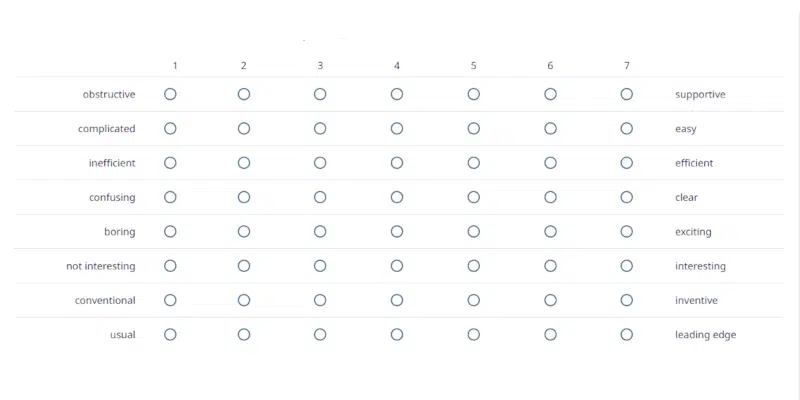
The design of digital products is becoming increasingly user-centered. Companies that create applications, e-commerce platforms, business systems, and websites understand that an attractive interface alone is no longer enough. What matters most is the overall user experience (UX). To effectively measure user satisfaction and evaluate the quality of interactions with a product, various research methods are employed. One of the most popular and widely recognized tools is the User Experience Questionnaire (UEQ).
What Is the User Experience Questionnaire?
The User Experience Questionnaire (UEQ) is a standardized survey designed to measure users’ experiences while interacting with a digital product. Developed by researchers specializing in usability and UX, its primary goal is to provide a quick and reliable assessment of user experience quality.
UEQ measures not only the practical usability of a product but also the emotional responses it evokes. As a result, organizations can better understand how users perceive an application, system, or website.
The questionnaire is widely used in both academic and business environments. UX designers, researchers, developers, product managers, and technology companies rely on it to develop products that align with user needs and expectations.
Why Is UX Research So Important?
A well-designed user experience directly impacts the success of a digital product. Even the most technologically advanced application can be rejected by users if it is difficult to use or unintuitive.
UX research helps organizations:
- Identify interface problems
- Increase user satisfaction
- Improve task efficiency and productivity
- Build a competitive advantage
- Increase conversion rates and sales
- Reduce user errors and frustration
UEQ enables organizations to quickly collect feedback from large groups of users, making it a highly practical tool in the design and optimization of digital products.
How Does UEQ Work?
The User Experience Questionnaire is based on a set of questions presented as pairs of opposite characteristics. Respondents evaluate a product using a seven-point scale positioned between two opposing terms, such as:
- Simple – Complicated
- Attractive – Unattractive
- Fast – Slow
- Modern – Outdated
The questionnaire typically consists of 26 questions divided into six primary UX evaluation scales. You can find a survey template at the Survey Examples page.
The Six Scales of the User Experience Questionnaire
1. Attractiveness
This scale measures the user’s overall impression of the product. It evaluates whether using the system is pleasant and satisfying.
Examples of assessed aspects:
- Whether the product generates positive emotions
- Whether users enjoy using the application
- Whether the interface appears visually appealing
Attractiveness often serves as a general indicator of overall user experience quality.
2. Perspicuity
Perspicuity refers to how easy it is to understand the product and learn how to use it.
The scale examines factors such as:
- Interface intuitiveness
- Ease of getting started
- Clarity of functions and messages
A high score indicates that users can easily navigate and understand the system.
3. Efficiency
The Efficiency scale measures whether users can accomplish their tasks quickly and effectively.
It evaluates:
- System responsiveness and speed
- Interface organization
- Ease of performing operations
Products with high efficiency enable users to achieve their goals with minimal effort.
4. Dependability
This scale assesses whether users feel in control of the system and whether the product behaves predictably.
It includes:
- Operational reliability
- System stability
- User sense of control
- Interface consistency
A low score may indicate chaotic behavior, unclear interactions, or a lack of trust in the system.
5. Stimulation
The Stimulation scale measures user engagement and motivation while interacting with the product.
It analyzes:
- Excitement during use
- Interest in the product
- Motivation to continue using the application
Modern digital products often compete by creating positive and engaging user experiences.
6. Novelty
The final scale evaluates how innovative and creative the product appears to users.
It considers:
- Originality of design
- Modernity of solutions
- Interface creativity
Products perceived as innovative are more likely to foster strong user engagement.
Advantages of Using UEQ
The User Experience Questionnaire has gained significant popularity due to several practical benefits.
Fast Administration
Completing the questionnaire usually takes only a few minutes, making it suitable for studies involving large groups of respondents.
Standardized Results
UEQ includes established interpretation models and benchmarks that allow organizations to compare their products against other systems.
Easy Analysis
Results can be quickly calculated and visualized through charts and reports. Specialized tools are also available to support data analysis.
Simultaneous Measurement of Usability and Emotions
Unlike many traditional usability methods, UEQ assesses both practical usability aspects and emotional user responses.
Versatile Application
The questionnaire can be used for:
- Mobile applications
- E-commerce websites
- ERP systems
- Websites and web portals
- Educational platforms
- Administrative systems
Limitations of UEQ
Despite its many strengths, the User Experience Questionnaire is not a perfect tool.
Limited Depth of Analysis
UEQ reveals the level of user satisfaction but does not always explain the underlying causes of problems. Therefore, it is often combined with interviews, usability testing, or other qualitative methods.
Subjective Responses
Results depend on respondents’ personal perceptions. Emotions, mood, and previous experiences can influence evaluations.
Need for Proper Interpretation
Incorrect analysis of results can lead to poor design decisions. For this reason, experience in UX research is important when interpreting UEQ findings.
UEQ in Business Practice
Organizations use UEQ at various stages of product development. The questionnaire can be administered:
- After launching a new version of an application
- During prototype testing
- Following a website redesign
- As part of a UX audit
- As a component of ongoing product quality monitoring
For example, an online store may discover through UEQ that users find the interface visually attractive but struggle to locate products efficiently. Such insights help teams prioritize and plan future improvements more effectively.
The Importance of UEQ in Modern Product Design
In today’s digital environment, competition among technological products is intense. Users expect not only functional systems but also convenience, speed, and positive emotional experiences.
The User Experience Questionnaire helps organizations better understand user needs and make data-driven design decisions. Through regular UX assessments, companies can create more intuitive, attractive, and effective digital products.
Conclusion
The User Experience Questionnaire (UEQ) is one of the most important tools used in UX research. It enables organizations to quickly and effectively evaluate user experiences in terms of usability, attractiveness, and emotional perception of digital products.
UEQ stands out for its simplicity, standardization, and ability to assess both practical and psychological aspects of user experience. Although it does not replace comprehensive qualitative research, it serves as a highly valuable component of a user-centered design process.
As modern organizations increasingly view UX as a strategic driver of business growth, the User Experience Questionnaire has evolved beyond a research instrument to become an important indicator of product quality and customer satisfaction.
NOTE. UEQ was designed by Andreas Hinderks, Martin Schrepp, and Jörg Thomaschewski. It is a scientifically validated, open-source, and free.