
Customer satisfaction is one of the key indicators for assessing how well your company manages the quality of its products, services, and customer care. The challenge, however, is that simply believing that “customers are satisfied” is not enough. To effectively manage the customer experience, you must regularly measure and analyze it— and, above all, act on the feedback received.
Implementing a customer satisfaction measurement program does not have to be a massive, complex undertaking. You can start with a simple online survey and gradually expand the system to include additional metrics, data collection channels, customer segmentation, automation, and integrations.
One tool that enables you to build such a process is SurveyLab — a platform for creating online surveys and conducting research on satisfaction, NPS, CES, and customer experience.
Where should you start when measuring customer satisfaction?
Start by defining your business objective and asking the question: What do you want to achieve with the research?
You may want to:
- Assess the quality of customer service.
- Check satisfaction with a product or service.
- Measure customer loyalty.
- Identify problems in the purchasing process.
- Assess the quality of support provided by your customer service team.
- Identify the reasons why customers leave.
- Monitor Customer Experience.
- Check whether the changes you have introduced have improved the customer experience.
A common mistake is to focus on the survey itself and start the project by asking: “What kind of survey should we create?”
CSAT, NPS or CES?
The objective of the research should determine both the survey design and the choice of metrics. If you want to assess a specific interaction, such as contact with customer service, CSAT may be a good choice. If you are interested in customer loyalty and willingness to recommend your company, NPS is worth considering. If you want to find out how easy it was for a customer to resolve a particular issue, CES can be useful.
There is no single metric that can answer all questions about customer satisfaction.
CSAT — Customer Satisfaction Score
CSAT is primarily designed to measure satisfaction with a specific experience.
For example: “How satisfied are you with the service you received?”
Customers can answer on a scale, for example, from 1 to 5. CSAT works well after contacting customer service, purchasing a product, receiving a delivery, or resolving a problem.
NPS — Net Promoter Score
NPS focuses on customer loyalty and their willingness to recommend your company.
The typical question is: “How likely are you to recommend our company to a friend or colleague?”
Respondents answer on a 0–10 scale, and the score is calculated based on the proportion of Promoters and Detractors. SurveyLab includes a dedicated NPS question type and automatic NPS calculation.
CES — Customer Effort Score
CES measures the effort a customer has to make to complete a specific task.
For example, you can ask: “How easy was it to resolve your issue?”
CES can be particularly useful when analyzing complaint processes, interactions with support, purchases, or the use of online services. SurveyLab supports NPS, CSAT, and CES, allowing you to use different metrics depending on the objective of your research.
Don’t try to measure everything with one survey
One of the most common mistakes when implementing customer satisfaction research is creating a very long questionnaire. You want to ask about the product, price, quality, customer service, delivery, website, app, complaints, and a dozen other elements. As a result, the survey becomes lengthy and customers are less willing to complete it. A better approach is to start with a few of the most important questions.
A sample survey could consist of:
- A CSAT or NPS question.
- A question about a specific aspect of the service.
- An open-ended question: “What could we do better?”
- Optional questions that allow you to assign responses to a customer segment. These questions can be replaced with information automatically passed from your CRM or e-commerce system.
Based on the results of the first survey, you can then decide which areas require more detailed analysis.
SurveyLab as a customer satisfaction measurement tool
SurveyLab allows you to create online surveys without installing additional software — all you need is a web browser. In addition to standard surveys, the platform supports Customer Experience research, CSAT, NPS, CES, and Voice of the Customer programs. An important advantage is the ability to adapt the way responses are collected to your customer service processes.
Surveys can be distributed through :
- Email.
- SMS.
- QR codes.
- Mobile devices.
- Widgets or pop-ups. Surveys embedded on a website.
SurveyLab also allows you to create dashboards, automated notifications, and integrations with systems used by your company, such as CRM, e-commerce, or data warehouses. This means that a survey can become part of an existing customer service process rather than a separate research project.
Ask customers at the right moment
The timing of a survey is extremely important:
- If you want to measure satisfaction with customer service, the survey should be sent shortly after the interaction has ended.
- If you are researching the purchasing process, you can ask the customer after they make a purchase or receive the product.
- If you want to measure overall loyalty, an NPS survey can be conducted periodically, for example once a quarter or twice a year.
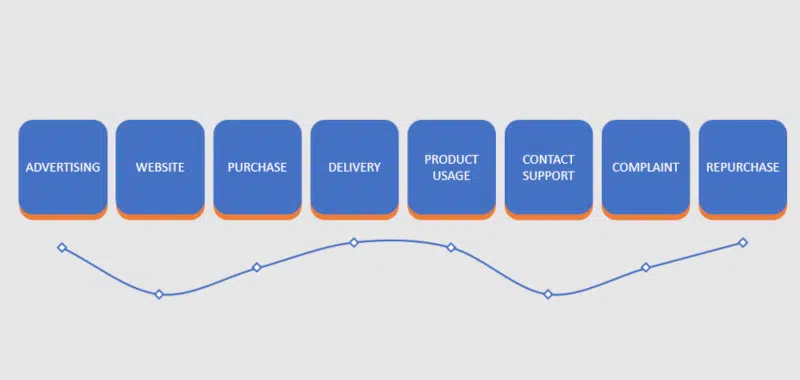
It is therefore worth defining the Customer Journey and identifying the most important customer touchpoints with your company.
It could look like this :
Advertising → Website → Purchase → Delivery → Product Usage → Contact with Support → Complaint → Repeat Purchase
You do not need to measure every stage right away. At the beginning, it is best to choose one or two of the most important ones.
Measure satisfaction at specific Customer Journey touchpoints
Overall NPS can tell you how a customer evaluates your company as a whole. However, it does not provide a precise answer as to what caused that rating. That is why it is worth combining relationship measurements with transactional measurements.
For example:
NPS:
“How likely are you to recommend our company?”
CSAT after contacting support:
“How would you rate the quality of the service?”
CES after resolving an issue:
“How easy was it to resolve your problem?”
This allows you to monitor both overall customer loyalty and the quality of individual customer experiences.
Use metrics and automated calculations
With a larger number of responses, manually calculating metrics quickly becomes inconvenient and increases the risk of errors.
SurveyLab allows you to create custom metrics based on survey responses. This makes it possible to create, among other things, complex satisfaction metrics such as the Customer Satisfaction Index (CSI), as well as automatically calculate NPS. This is particularly important when you want to combine several questions into a single index.
For example, a CSI may take into account:
- Product quality.
- Service quality.
- Delivery time.
- Value for money.
Each element can be assigned an appropriate weight, and the final score can be used to monitor changes in customer satisfaction over time.
Analyze not only the results but also customer comments
A CSAT or NPS score tells you what is happening, but often does not tell you why. That is why it is worth adding an open-ended question after a rating question:
“What is the main reason for your rating?”
Customer comments can provide information that cannot be obtained from a numerical scale alone.
If several hundred customers start mentioning:
- Long waiting times.
- Delivery problems.
- Difficulty contacting support.
- A missing feature.
- Problems with the app.
You get a very specific list of areas that need improvement. With a large number of responses, text analysis can also be automated through comment categorization or sentiment analysis.
Segment your customers
The average score for the entire company often does not tell the full story. Suppose your CSAT is 85%. At first glance, this may seem like a good result. However, after segmenting the data, you may discover that :
- New customers: 91%.
- Returning customers: 87%.
- Customers using Product A: 94%.
- Customers using Product B: 71%.
Segmentation reveals the problem. In customer satisfaction research, it is therefore worth analyzing results by product, sales channel, region, customer type, or Customer Journey stage, among other factors. SurveyLab allows you to filter results and work with data to analyze different respondent groups.
Turn feedback into action
The most important element of the entire process is responding to customer feedback.
You can build a simple mechanism:
Customer gives a low rating → System identifies response → Appropriate person receives a notification → Employee contacts customer → Problem is resolved.
This is an example of closed-loop feedback. In this model, the survey is not merely a reporting tool. It becomes part of the customer service process. SurveyLab offers automated notifications and support for closed-loop processes, allowing you to connect feedback collection with an organizational response to the feedback received.
Connect surveys with your CRM and other systems
In a small company, survey results can be analyzed manually. In a larger organization, it is worth automating the data flow.
For example:
CRM → SurveyLab (Survey) → Customer Response → SurveyLab (Analysis) → CRM / BI → Customer Service Team
Through integration, you can pass customer or transaction information to the survey and then connect the response with existing business data. SurveyLab supports integration with customer-side systems, including CRM, e-commerce, and BI/DWH, allowing research to become part of your existing data architecture.
Start with a pilot
There is no need to begin with an implementation covering the entire organization. A pilot is often a better approach.
For example:
| Time | Action |
|---|---|
| Week 1 | Define the objective and select the metric. |
| Week 2 | Create the survey in SurveyLab and integrate it with the selected distribution channel. |
| Weeks 3–4 | Collect responses. |
| Week 5 | Analyze results and comments. |
| Week 6 | Implement the first improvements. |
| Following month | Measure again. |
This approach allows you to quickly determine whether your methodology works before rolling it out across the entire organization.
What can a basic measurement program look like?
To begin, you can use a simple model:
| Element | Example solution |
|---|---|
| Objective | Measure service quality |
| Metric | CSAT |
| Survey timing | After completing a support interaction |
| Survey | 3–4 questions |
| Channel | Email or SMS |
| Analysis | SurveyLab Dashboard |
| Segmentation | Product, channel, customer type |
| Alert | Low rating |
| Action | Employee contacts the customer |
| Follow-up | Repeat measurement |
Once the basics are in place, you can add NPS, CES, additional Customer Journey touchpoints, automation, segmentation, and CRM integration.
SurveyLab — from a single survey to a Customer Experience system
Customer satisfaction measurement should be treated as a process rather than a one-time survey. SurveyLab allows you to start with a simple CSAT or NPS survey and then expand the solution with CES, custom metrics, dashboards, segmentation, automated notifications, multiple distribution channels, and integrations with your business systems. This allows you to gradually move from a simple question:
“Is the customer satisfied?”
to a much more valuable system :
“What influences customer satisfaction, where do problems occur, which customers are affected, and what actions should we take?”
Summary
Effective customer satisfaction measurement is not about sending one survey and calculating an average score.
It is a process that includes :
Objective → Metric → Survey → Right measurement moment → Data collection → Analysis → Action → Repeat measurement.
It is worth starting with a small pilot, using one or two key metrics, and gradually expanding the system. SurveyLab can support the subsequent stages of this process — from creating surveys and measuring CSAT, NPS, and CES, through distribution and data analysis, to automation, dashboards, and integration with business systems. The most important thing, however, is that customer feedback does not end up in a report.
A good customer satisfaction survey does more than measure the customer experience. It helps improve it.