
The Net Promoter Score (NPS) is attracting increasing attention, as more organizations choose to measure customer loyalty through NPS rather than traditional satisfaction metrics.
Developed by Fred Reichheld, Bain & Company, and Satmetrix, NPS was first introduced in a 2003 Harvard Business Review article titled “The One Number You Need to Grow“. Since then, it has become one of the most widely used customer experience metrics across industries – from tech giants like Apple and Amazon to airlines, banks, and even public institutions.
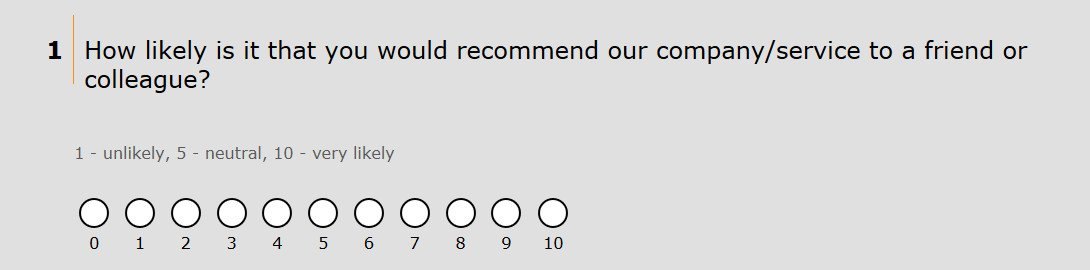
The concept behind Net Promoter is simple. Respondents are asked a single question : “How likely is it that you would recommend our company / service to a friend or colleague?“. They respond on a scale from 1 to 10. Those who give a score of 9–10 are classified as Promoters, 7–8 as Passives, and 0–6 as Detractors.
Depending on their rating, respondents may be asked follow-up questions to elaborate on what they like or dislike about the company or its services.
The goal is to maximize the number of Promoters while minimizing the number of Detractors. The NPS is calculated by subtracting the percentage of Detractors from the percentage of Promoters.
Net Promoter Score = (% of Promoters) – (% of Detractors)
An NPS of around 70% is considered excellent, although benchmarks may vary by industry. For example, streaming services and luxury brands often achieve higher scores, while telecom and utility companies tend to have lower averages due to the nature of their markets.
Companies with a high NPS are statistically more likely to achieve faster revenue growth than competitors with lower scores. According to Bain & Company, leaders in NPS typically outperform their peers by more than double in growth rates.
Net Promoter, NPS, and Net Promoter Score are registered trademarks of Satmetrix Systems, Inc., Bain & Company, and Fred Reichheld.